


- by Daniel Pawlik
Japandi style – what is it and how to design an interior in the spirit of Japandi?
- by Daniel Pawlik
The Japandi style is one of the most beautiful answers to the noise of modern life. It combines Japanese depth, Scandinavian warm simplicity, and the deeply human need for a space where one can truly breathe. This is not a fleeting trend – it is a philosophy of home decor that lasts for years because it is based on things that do not age: quality materials, natural textures, and silence between objects.
At Pillovely, we see that the Japandi style is chosen by people who value peace, but also by those who do not want to give up the personal character of their interior. It is an aesthetic where you can be yourself without shouting with color or pattern. In this guide, we will show you what Japandi is, what rules govern it, and how to decorate a living room and bedroom in its spirit, as well as how to choose furniture that truly harmonizes with this philosophy.
The question "what is Japandi style?" is becoming more frequent, as the name appears literally everywhere – from interior magazines to Instagram. Simply put: Japandi is a fusion of Japanese minimalism with the warmth of Scandinavian simplicity. The name is a portmanteau of the words Japanese and Scandinavian and was coined relatively recently, although the aesthetic it describes has roots going back decades.
Why do these two traditions get along so well? Because they share fundamental values:
Quality over quantity – fewer but better things.
Respect for craftsmanship – visible wood processing, hand-woven wool, ceramics that are imperfect but real.
Functionality as a foundation – every piece of furniture has meaning and its place.
Closeness to nature – wood, linen, stone, bamboo, plants.
The philosophy behind Japandi:
wabi-sabi (from Japanese) – beauty in imperfection, in the aging of things, in simplicity,
hygge (from Danish) – a feeling of coziness, community, warmth,
ma – conscious use of empty space as a full-fledged element of composition,
lagom (from Swedish) – "just right," balance, no excess.
Japandi interiors are visually low-budget, but they require conscious choices. It's not about having little – it's about having the right things. Japandi style is not for people who love "more, stronger, brighter." It's for those who seek peace and depth in their home.

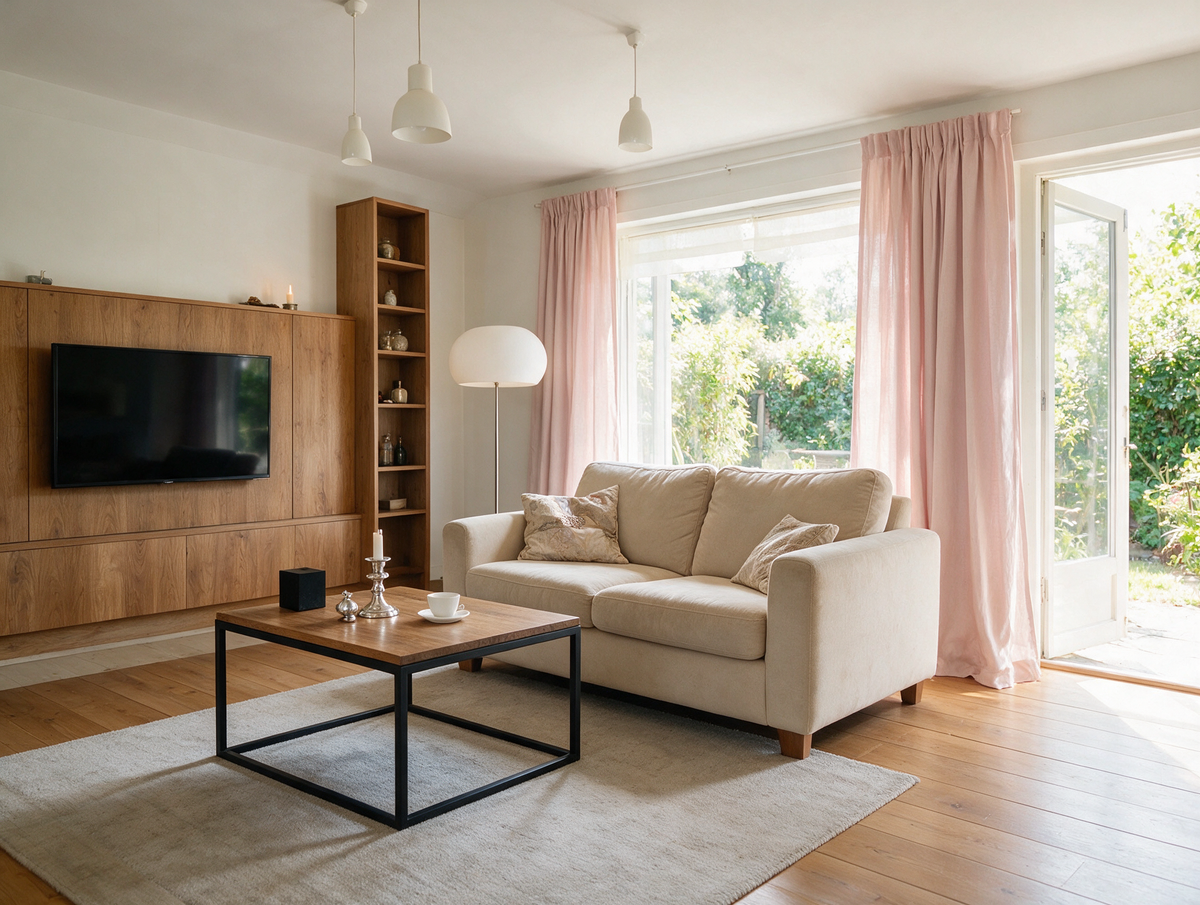
A Japandi arrangement in the living room begins with the color and material base. A Japandi-style living room is not meant to be empty – it is meant to be calm. That's a big difference.
Colors in Japandi come from nature and are meticulously thought out. The main palette includes:
warm whites and ecru – base for walls, large surfaces,
sands, beiges, creamy shades – upholstery, textiles,
muted greens – moss, olive, bottle green – as accents,
terracotta and warm browns – in accessories,
deep black and dark wood – in single, strong elements.
There is one rule: a maximum of three dominant colors + one strong accent. Scandinavian Japandi style avoids garish combinations, and Japanese avoids anything that distracts the eye.
A Japandi arrangement is based on texture, not pattern. Materials should be authentic, tactile, aging gracefully:
wood – light (oak, ash, birch) or dark (walnut, burnt oak),
linen and cotton – bedding, curtains, throws, decorative pillows,
stone and ceramics – pots, vases, display dishes,
bamboo, rattan, rice paper – accents, lamps, screens,
wool and string – rugs, blankets, small textiles.
Horizontal lines and low furniture. A Japandi living room features furniture lower than classic European styles – a low sofa, a low coffee table. This visually opens up the space and creates a feeling of calm.
Asymmetry instead of symmetry. In Japanese tradition, an asymmetrical arrangement is more beautiful than perfect symmetry. Two different lamps instead of a pair of identical ones. A plant on one side, a picture on the other.
Empty space matters. Don't fill every shelf. Don't arrange furniture "around the perimeter of the room." Allow empty wall sections to speak for themselves – in Japandi, emptiness is not a lack, it is a conscious element.
One plant, but real. Bonsai, ficus, monstera, a flower on a long stem in a vase – one good plant replaces ten small ones. Avoid artificial flowers. Japandi interiors are alive with real life.
Warm, soft, multi-point lighting. A central ceiling lamp + a floor lamp + a table lamp is standard. Paper shades, natural materials, color temperature 2,700 K. No cold LEDs.
In a Japandi living room, the sofa plays a central role – it's worth investing in a model in a neutral fabric (linen, cotton, soft velour in a sandy shade). Models that fit this aesthetic well can be found in Pillovely's sofa collection – especially those in neutral beiges and with wooden legs.
The bedroom is where the Japandi style fully develops its potential. Its entire philosophy – unwind, surround yourself with quality, breathe – finds its most natural application here.
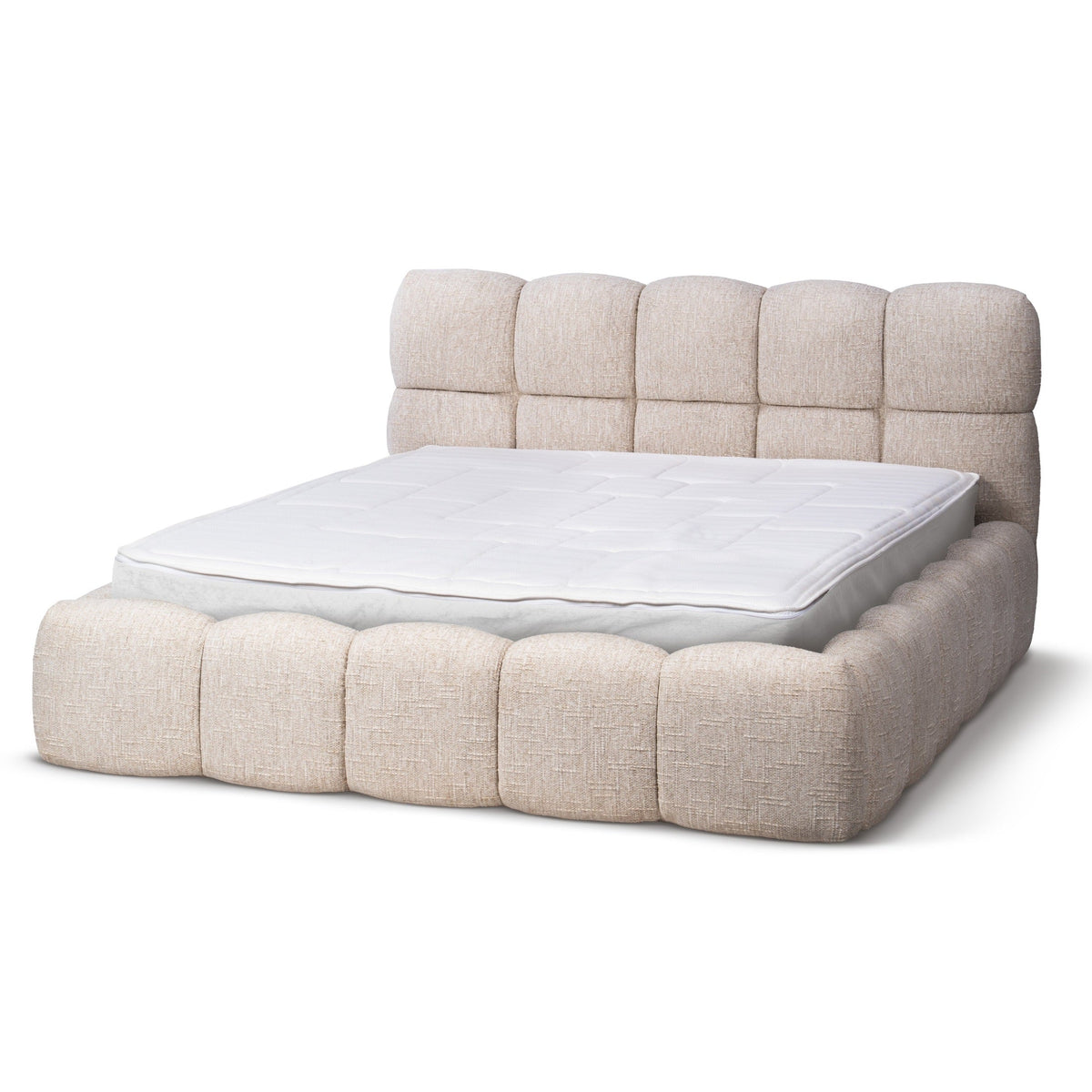
A Japandi style bedroom bed is usually:
low (30–45 cm high), inspired by the Japanese tradition of a low mattress,
with a wooden or upholstered frame – in natural shades,
without an overly high headboard – if there is a headboard, it is simple, in linen or velour in a calm color,
without ornate carving, without ornaments – a clean, raw, but warm line.
A low bed visually enlarges the room and introduces that characteristic "horizontal" composition. Beds in this spirit can be found in Pillovely's beds category – choose models made of solid wood or upholstered in linen/cotton.
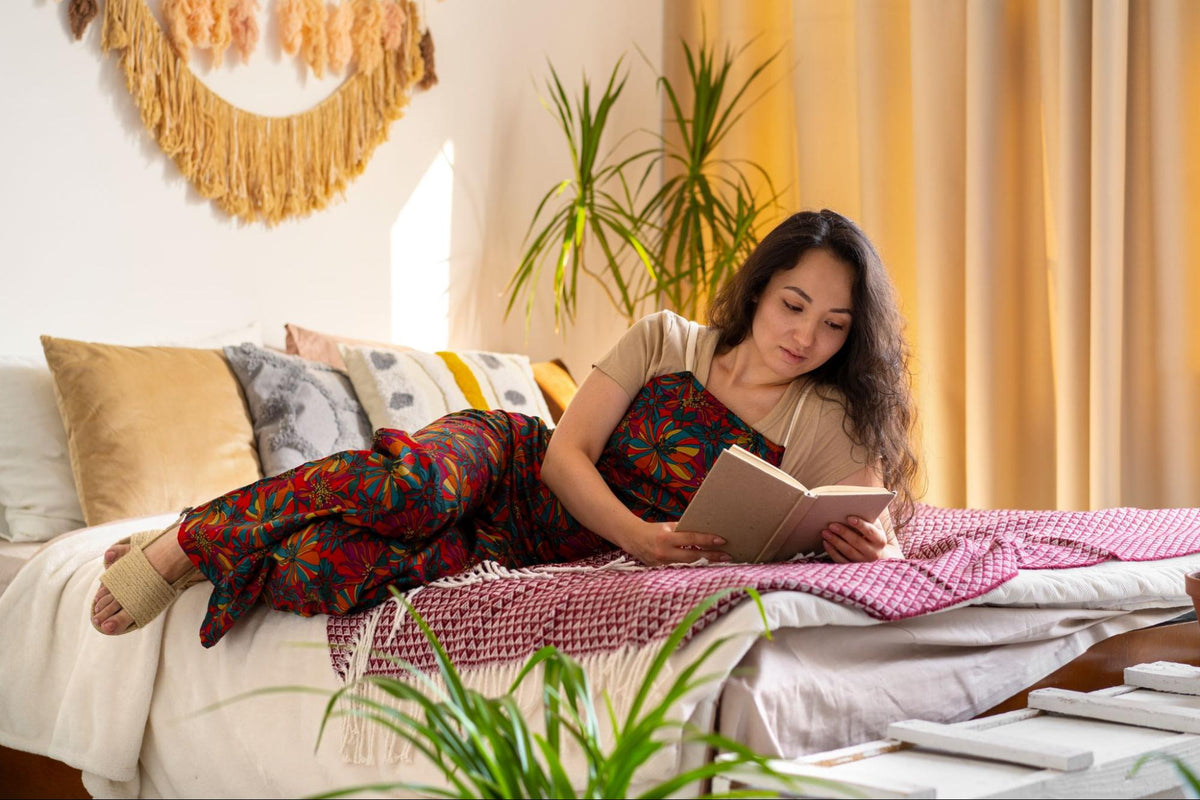
The Japandi arrangement in the bedroom is based on natural fiber textiles:
linen or cotton bedding – in sand, oat, soft gray, misty green colors,
a wool throw – adds texture and visual weight,
a few decorative pillows – a maximum of three, in a coherent palette,
a short-pile rug – in a neutral color, not too patterned.
Avoid satin, glossy surfaces, heavily patterned bedding. A Japandi style bedroom rewards simplicity and authenticity.
Furniture in a Japandi bedroom relies on a few, well-chosen elements:
a wooden chest of drawers – low, wide, with simple fronts (no glossy lacquer),
a wardrobe with sliding doors – in light wood or matte white,
nightstands – simple, wooden, sometimes with rattan weave,
a bedside lamp with a paper shade or in an opaque glass hue.
Models of chests of drawers and wardrobes suitable for this aesthetic can be found in Pillovely's chests of drawers category and wardrobes category. Choose those in light wood shades and with minimalist handles (or no handles – with a push-to-open system).
In a Japandi bedroom, less is more. One plant (sansevieria, ficus). One floor lamp. A candle in a ceramic holder. A book on the nightstand. That's all – and yet so much.
Choosing Japandi style furniture is a game of "less, but better." You don't buy an entire set from a catalog – you curate the interior piece by piece, with care and deliberation. Here's what to look for.
Natural material in the foreground. Solid wood, real wood veneer, linen, cotton, wool, rattan. Particleboard covered with a foil wood imitator does not fit this aesthetic – even if it "looks similar."
Clean lines. Japandi style furniture is geometrically simple: rectangles, ovals, softly rounded corners. No carving, no ornaments, no plastic fittings.
Visible craftsmanship. Mortise and tenon joints, visible grain, natural knots in the wood – all that would be hidden in other styles is exposed in Japandi. This is wabi-sabi in practice.
Low silhouette. Sofas with low backs (up to 80 cm), beds 30–45 cm high, coffee tables 30–35 cm. Japandi arrangement "lies" on the floor, it doesn't "stand" vertically.
Thin legs or full body on the floor. Two schools – furniture on thin, black or wooden legs (Scandinavian accent) or furniture "sitting" on the floor, without legs (Japanese accent). Choose one school in the room, do not mix.
If you are building a Japandi interior from scratch, this order of purchase makes sense:
Sofa in linen or velour in sand, olive or warm gray tones – the heart of a Japandi living room,
Coffee table made of solid wood or stone – a strong single element,
Low bed with a wooden frame or upholstered in linen,
Chest of drawers or wardrobe in light wood with simple fronts,
Dining chairs made of bent wood or woven material – models inspired by Japanese simplicity,
Dining table made of solid wood with a natural finish.
Specific product proposals fitting the Japandi style can be found in Pillovely's current offer – it's worth starting from the homepage and browsing the categories of sofas, tables and chairs. By filtering by colors (beige, olive, natural wood) and materials (linen, solid wood) you will quickly build a coherent list.
Wood imitation on laminated board – does not fit this aesthetic, even though it is cheaper,
Glossy lacquers – Japandi style is about matte finishes,
Strong patterns on fabrics – in Japandi, fabrics are smooth or have a delicate texture, without patterns,
"Furniture sets" in one design – Japandi is a mix of well-chosen individual pieces of furniture, not a set of 5 elements from one catalog,
Chrome fittings and legs – if metal, then matte black or patinated brass. Chrome disrupts the peace of the composition.

What is Japandi style?
It's a combination of Japanese minimalism and Scandinavian coziness.
What colors suit Japandi?
Beiges, whites, warm grays, olive, wood, and soft browns.
What materials should be chosen for a Japandi interior?
Preferably wood, linen, cotton, stone, rattan, and ceramics.
Is Japandi suitable for small apartments?
Yes, because it emphasizes simplicity, order, and a light, calm arrangement.
What furniture suits the Japandi style?
Low, simple furniture made from natural materials, without unnecessary ornaments.
What to avoid in Japandi style?
Shiny surfaces, strong patterns, excessive decorations, and artificial materials.
Japandi style is more than just aesthetics. It's a way of thinking about home that emphasizes quality, tranquility, and authenticity. In a world of constant excess – information, stimuli, things – a Japandi interior acts like a deep breath.
Three key takeaways from this text:
Less, but better. Japandi interiors are not empty spaces, but thoughtfully designed – every piece of furniture has its place and meaning.
Nature everywhere. Wood, linen, stone, plants, paper. Materials that live and become more beautiful with time.
Serenity before effect. Japandi arrangements are not meant to "impress". They are meant to make you want to come home.
At Pillovely, we design furniture for people who seek peace, warmth, and authenticity in their homes. Japandi style is a natural direction for us – because it combines nostalgia for a simple home with a modern awareness of how we want to live. Pillovely – for those who want more. More quiet. More their own. More at home.
If you liked this text, be sure to check out our other inspirations:
Gaming room – how to create a modern and functional space for a gamer?
Loveseat - What Is It, Who Is It For and How to Choose the Right One?
A loveseat is one of those pieces of furniture that can completely change how a room works. It is smaller than a classic sofa, more generous than a single armchair and often easier to place in compact interiors. A loveseat can create a cosy sitting area in a small living room, soften a bedroom corner, complete a reading nook or work as an additional seat next to a larger sofa. Its strength lies in proportion: it gives you the feeling of a sofa without taking over the whole room.
Read moreabout Loveseat - What Is It, Who Is It For and How to Choose the Right One?
EU vs UK Bed Sizes – Will UK Bedding Fit a European Bed?
European beds are 200 cm long, UK beds 191 or 198 cm. A simple EU vs UK bed size table in cm – and what it means for your mattress and fitted sheets.
Read moreabout EU vs UK Bed Sizes – Will UK Bedding Fit a European Bed?
Autumn colors at home – shades that bring peace and warmth
Do you remember autumn from your childhood, when the leaves changed color like a kaleidoscope, and your mom would pull out the pumpkin-colored sweater she'd worn since college? Or those evenings in front of the TV while a storm raged outside, and the lamplight in the house gave everything a warm, amber hue? Those were the days when no one talked about "color palettes" or "color stories"—colors simply existed, as natural as breathing. Today, when we can choose from 50 shades of gray (and no, I'm not talking about THAT book), we sometimes lose track of what truly makes a home feel cozy. At Pillovely, we believe that autumn colors aren't a trend—they're a return to what makes us feel safe. Because "You are someone"—someone who deserves a space filled with colors that snuggle like a grandma's blanket.
Read moreabout Autumn colors at home – shades that bring peace and warmth



Share:
Pilla's Reading Corner: "Charlie and the Chocolate Factory" - Roald Dahl
How to Choose a Sofa for Your Living Room? A Complete Buying Guide