


How to split a children’s bedroom in two – and create a space where siblings can get on well
- by Daniel Pawlik
Sharing children’s bedroom Sharing a bedroom between two children is one of the most common challenges in Polish homes – not everyone has space for two separate rooms, and siblings of different ages and with different tastes must somehow find common ground within a single space. The good news is that a room for two children can be planned so that each has their own space, whilst the whole room maintains a consistent style.
The key is personalisation without chaos. Every child needs their own bed, their own seating area and a bit of space to decorate in their own way – but the base (wall colours, furniture style) should be neutral and shared, so that the room doesn’t look like two separate worlds forced together.
In this guide, we outline specific solutions: how to choose beds, when a bunk bed is the right choice, how to personalise the space with pouffes and cushions, and what mistakes to avoid so that the siblings’ room is a place of harmony rather than a daily battle for territory.
In short: A children’s bedroom for two children needs a shared, neutral base (colours, furniture style) and separate personalisation zones for each child. A bunk bed saves up to 3–4 m² of floor space compared to two separate beds, and the cost of basic furnishings for a shared room is usually €1200–€2150.
Dividing the room starts with the sleeping area – a space that must feel like ‘their own’ to each child. A good solution is to have two identical beds in different colours – upholstered bed In a subtle beige for the older child and in their favourite shade of pink or blue for the younger one, this is a simple way to maintain harmony whilst respecting each child’s individuality.
The second area is a space for learning and play. It doesn’t have to be separate for each child – a shared small table In the morning, it can be used for doing homework, and in the afternoon it can be transformed into a space for building with blocks. More important than the number of pieces of furniture is teaching children to respect each other’s needs – they decide for themselves who uses the shared space and when.
The third zone is personalisation – a wall, a shelf or a section of the floor where each child can decorate as they please, without interference from their siblings. It is this zone that most often determines whether children feel that the room is ‘theirs too’, rather than just a shared space.

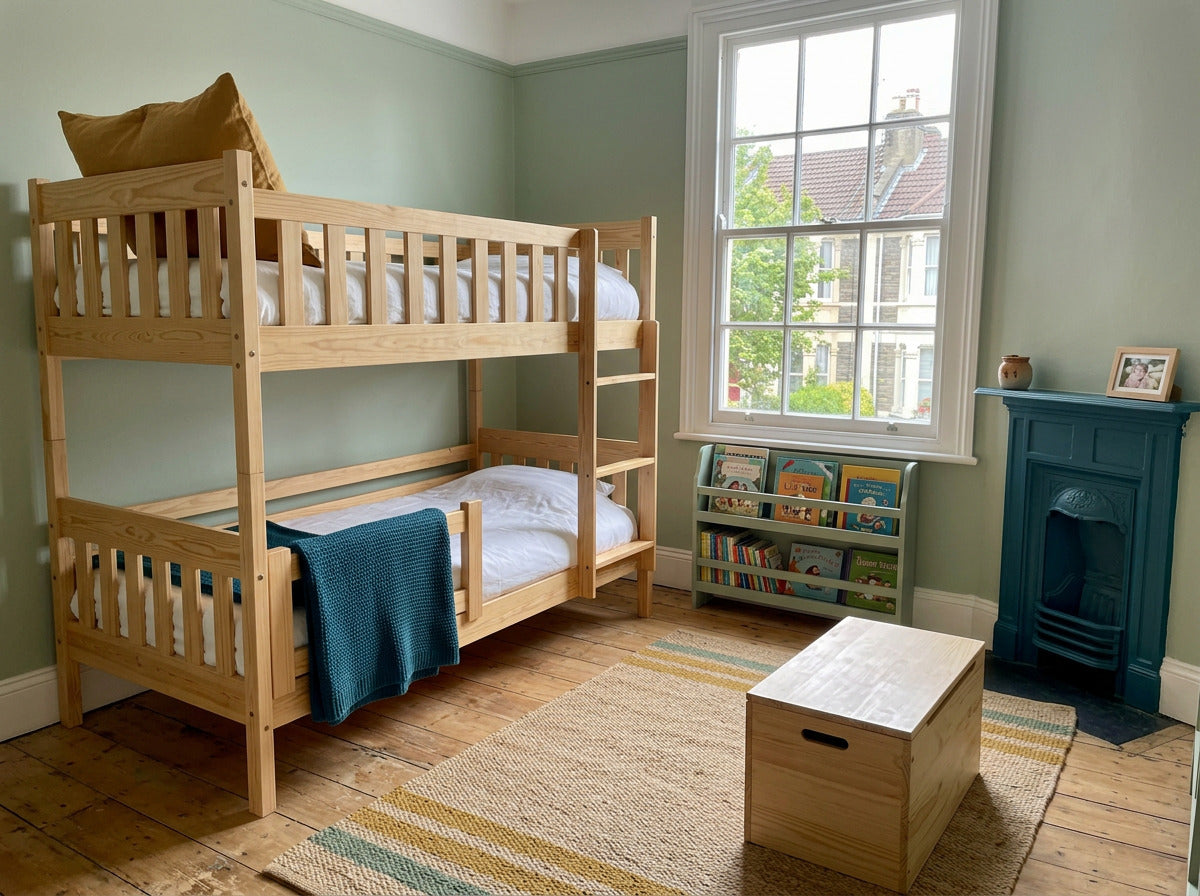
Bunk bed This is the most common choice in small bedrooms for siblings, as it takes up as much floor space as a single bed, rather than two. Modern models are much sturdier than those from many parents’ childhoods – they often feature an additional desk or play area in the lower part of the structure. An example of this is Frelu bunk bed (168x86x141 cm, from €489) or a bunk house Dari – both made from solid pine, with a safety rail on the upper level. You can find the full range in the collection children’s beds.
If the room is larger than 12–14 m², two separate upholstered beds (e.g. 120x200 or 140x200 cm) offer more freedom – each child has complete privacy in the space around their bed, which can be more important than having a few extra metres for playing. Smaller rooms (up to 10–12 m²) are generally better suited to bunk beds or compact beds with storage for bedding.
The decision also depends on age: children under 6 should not sleep on the top bunk of a bunk bed for safety reasons – in such cases, two separate, low beds placed side by side are a better option.
Pouffes and seats are the ideal solution for personalisation without permanent changes – they are portable, colourful and can be moved around. Each child can have their own pouffe in their favourite colour, which they can move to any spot in the room – it’s their little throne in their shared kingdom.
The room’s colour scheme (beiges, soft greens, natural wood) should be neutral and consistent – it is against this backdrop that each child adds their own touches: the younger one might choose pink decorative cushions, the older ones – posters of their favourite artists. This variety against a neutral background creates harmony rather than clutter.
Mattresses with removable covers and cushions that can be moved around freely give children practical tools to create their own space – without having to repaint the walls every few months.

The first mistake is the lack of a clearly defined ‘personal’ space for each child – if everything is shared, conflicts arise over every centimetre. The second is insisting on a single style (e.g. only pink or only blue) that suits one child’s taste, whilst the other feels like a guest in their own room.
The third mistake is ignoring the age difference – the older child needs privacy and a place to study, whilst the younger one needs space to play, and trying to cram both needs into an identical furniture layout rarely works. The fourth is an overly rigid ‘fifty-fifty’ division that fails to take real proportions into account – sometimes the older child, who spends more time at their desk in the room, needs more space than the younger one.
| Product | Dimensions | Price from | Usage |
|---|---|---|---|
| FJORD upholstered bed | 140 or 160 x 200 cm, with storage | €919 | two identical models in different colours |
| Frelu children’s bunk bed | 160x80 cm, 2 levels | €489 | One bed for two children, a small room |
| Softly pocket spring mattress | 80–120 x 200 cm | €96.98 | one mattress per child |
| May Pouffe | 140 cm | €255.76 | mobile personalisation zone |
| Gorky coffee table | 103x38 cm | €109 | a shared space for learning and play |
| Star decorative cushion | star symbol | €49 | a personalised touch on every page |
There is no one-size-fits-all solution for a shared bedroom – it depends on your family’s history, your children’s personalities and the space available. A neutral base, separate personalised zones and furniture that grows with your child form the foundation on which you can build a room where siblings will learn to share space – and, in the process, to compromise and respect each other’s boundaries.
The room is divided into three zones: a sleeping area with a separate bed for each child, a shared study or play area, and a personalisation zone (wall, shelf), where each child can decorate it in their own way. The colour scheme and style of the furniture should be shared and neutral.
A bunk bed works best in rooms up to 10–12 m², as it takes up as much floor space as a single bed. In larger rooms (over 12–14 m²), two separate upholstered beds give each child more privacy and personal space around their bed.
A comfortable room for two children starts at around 10–12 m² with a bunk bed or compact beds with storage. In a space smaller than 10 m², it is difficult to fit two full-sized study areas, so it is worth opting for one shared table instead of two desks.
The older child needs a place to study and more privacy, whilst the younger one needs space to play on the floor. It is worth separating these functions physically (e.g. a desk on one side, a play corner on the other) and giving the older child more space if they spend more time in the room.
A neutral base works best – beiges, natural wood, soft greens – to which each child can add their own colour accents with cushions, bed linen or posters. Avoid pre-assigned ‘boy’ and ‘girl’ colours as the main theme for the whole room.
The most common mistakes include failing to provide a separate personal space for each child, imposing a single style that suits only one of them, ignoring differences in age and needs, and a rigid ‘half-and-half’ division without taking into account how the room is actually used.
Every child should have their own bed, their own shelf or wall to personalise and – if possible – a physical element to separate the areas, such as a bookcase, a curtain or another piece of furniture. It is also important to have clear, mutually agreed rules for using shared items, such as a table or a bookcase.
The basic furnishings for a shared bedroom (two beds, mattresses, a shared table, basic storage) usually cost €1200–€2150, depending on the models and dimensions chosen. Pouffes, cushions and personalised accessories add a further €100–€200 per child.
A compact coffee table works well, such as the Gorky 103x38 cm with a shelf – large enough for two children sitting on opposite sides, yet without taking up too much space in a small room. For older siblings, a taller table or a desk with two seats is often a better choice.
Pillovely – a love of cosy homes. For those who want more.
What Size Bed Fits Your Bedroom? A Room Size Chart
Do you remember rearranging your childhood bedroom furniture every few months, convinced that if the bed just went against the other wall, the whole room would finally feel right?
Read moreabout What Size Bed Fits Your Bedroom? A Room Size Chart
What sofa is best for a small living room? Compact models that fit
Read moreabout What sofa is best for a small living room? Compact models that fit
Bunk Beds for Kids – Age, Weight Limits and Safety Explained
A bunk bed is a great way to save space in a room shared by siblings, but it comes with a few safety rules – the child's age, the weight limit, and properly designed guardrails. Here's the age it's recommended from, and how much weight the top and bottom bunks are built to hold.
Read moreabout Bunk Beds for Kids – Age, Weight Limits and Safety Explained


Share:
What does transitional style mean – a bridge connecting timeless elegance and contemporary simplicity
How to clean vintage Christmas ornaments – restoring grandma’s baubles