


- by Daniel Pawlik
How to arrange furniture in the living room? A practical guide to space arrangement
- by Daniel Pawlik
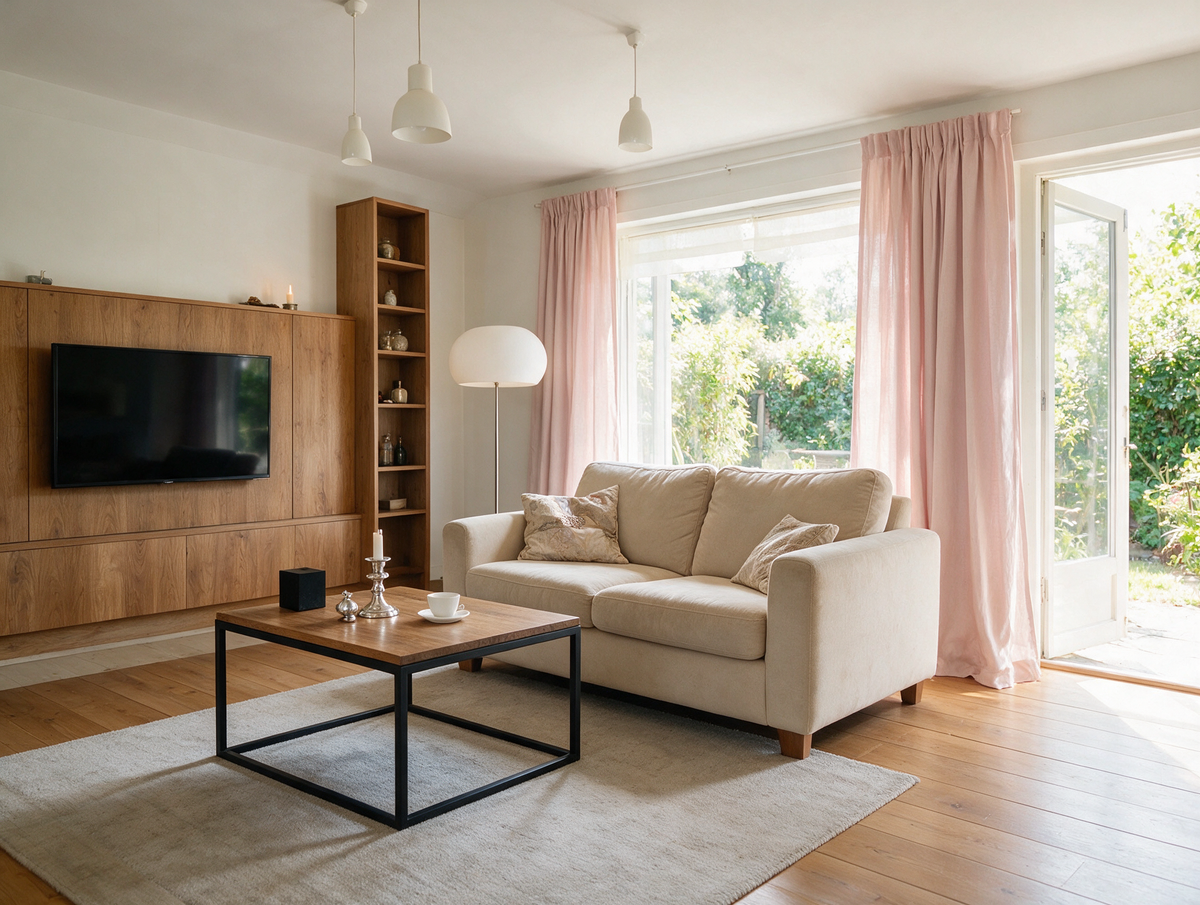
The living room is the space where we spend most of our time – watching movies, hosting guests, or simply relaxing with a cup of tea. That's why the arrangement of furniture in it is more important than it might seem – it determines whether the room promotes relaxation or irritates us daily.
In this guide, we show you where to start planning your furniture layout, how to position a sofa and corner sofa in relation to the TV and windows, how to gain space in a small living room, and how to define clear zones in a room with a TV and fireplace.
Before moving the first piece of furniture, it's worth taking a moment to accurately measure the room – wall lengths and widths, and the placement of doors, windows, radiators, and electrical outlets. This is the foundation that helps avoid situations where your dream sofa turns out to be a few centimeters too big or blocks the balcony doors.
A good practice is to draw a simple floor plan – by hand on paper or using one of the free interior planning applications – and mark the dimensions of the furniture you plan to arrange. This way, you'll see on a flat plan what's hard to judge "by eye" while standing in an empty room.
The next step is to determine the main focal point around which the living room should be organized. In most homes, this is the television, but it could just as easily be a fireplace, a large window with a view, or simply a conversation area. It's best to start arranging furniture around this element – the rest of the layout will naturally fall into place around it.
The last, often overlooked rule is to leave adequate communication paths – that is, space through which one can freely move from one point in the room to another without bumping into furniture. The standard is to leave at least 60–90 cm width for the main passageway and about 40–45 cm distance between the sofa and the coffee table for comfortable getting up and sitting down.
It's also worth thinking about how the living room is used daily by all household members. A family with small children will need more free floor space for play, while a two-person household might more freely arrange several smaller zones – for example, a reading corner next to the main lounge area. Before permanently arranging furniture, it's worth observing for a few days how you actually move around the room and which routes are most frequently taken.

The distance between the sofa and the television is one of the most frequently overlooked elements of interior design, yet it directly affects viewing comfort. The general rule is that this distance should be about 2.5–3 times the diagonal of the television – for a 55-inch screen, this means approximately 3.5–4 meters. In smaller living rooms where such a distance is difficult to achieve, a TV with a smaller diagonal will work better than a sofa placed too close to the screen.
Equally important is the positioning of the sofa or corner sofa in relation to natural light sources. It is advisable to avoid situations where the TV is directly opposite a window – light reflections on the screen during the day significantly hinder viewing. A better solution is to place the TV sideways to the window, and the sofa so that people sitting have the window to their side, not behind them or directly in front of them.
A corner sofa, due to its form, works well as an element that "encloses" space – placed against a wall or in the corner of a room, it saves space in the central part of the living room while offering more seating than a traditional sofa. However, it's worth remembering to match the direction of the corner sofa (left or right) to the room's layout – from the side you naturally enter the living room, and from the window side, so as not to block light access to the rest of the room.
In small living rooms, it's crucial to think about furniture not only in terms of "what will fit," but also "what will optically enlarge the space." The first rule is to arrange furniture parallel to the walls, not diagonally – furniture placed at an angle, although sometimes visually interesting, in a small room eats up valuable centimeters and hinders free movement.
A good solution in small living rooms is furniture on tall, slender legs instead of solid, massive bases – the visible space under the furniture optically "lightens" the interior and makes the room appear larger than it actually is. For the same reason, it's worth considering a small, glass or visually light coffee table instead of a large, massive low table.
It's also worth considering multi-functional furniture – a sofa with a sleeping function and a bedding container, or a table with an additional shelf, allows you to reduce the number of separate pieces of equipment in the room, which directly translates into more free floor space. In a small living room, the "less is more" principle also applies – it's better to opt for a few well-thought-out, quality pieces of furniture than to fill the room with numerous small items.
Living rooms that need to reconcile two central points – a television and a fireplace – require a more thoughtful plan than a standard layout. The most common solution is to position the sofa perpendicular to both points, so that from one seating position, one can comfortably observe both the screen and the fire in the fireplace, without constantly having to turn.
It's also a good practice to physically define zones using a rug – the seating area with a sofa, corner sofa and coffee table can be placed on one rug, while the TV cabinet with the television remains outside its boundary, creating a natural, visual division of the room without the need for partition walls.
In larger living rooms, where there is space for a separate seating area by the fireplace and a separate TV area, it is worth considering arranging two smaller groups of furniture instead of one large one – for example, two armchairs by the fireplace and a sofa opposite the TV. Such a layout supports various ways of spending time in one room – from an intimate conversation by the fire to an evening movie screening with a larger group.

A well-planned furniture arrangement is not a matter of blindly following fleeting catalog trends, but a thoughtful investment in the daily well-being and comfort of all household members. A properly arranged space guarantees free movement through the room without bumping into edges, optimal viewing angles during movie screenings, and a harmonious atmosphere that naturally encourages you to stay longer. Before you permanently place the first piece of furniture or make final purchases, it's worth taking the time to test various configurations and thoroughly analyze the needs of your home.
If you are looking for furniture to help you create a functional, ergonomic, and cozy living room, visit Pillovely. Check out our latest collections of modular sofas, pull-out corner sofas, spacious TV cabinets, and designer coffee tables – you'll find refined models perfectly suited to any size, functional layout, and individual character of your interior.
If you enjoyed this text, be sure to check out our other inspirations:
Glamour style in interiors – what is it and how to furnish a living room and bedroom in glamour style?
Loveseat - What Is It, Who Is It For and How to Choose the Right One?
A loveseat is one of those pieces of furniture that can completely change how a room works. It is smaller than a classic sofa, more generous than a single armchair and often easier to place in compact interiors. A loveseat can create a cosy sitting area in a small living room, soften a bedroom corner, complete a reading nook or work as an additional seat next to a larger sofa. Its strength lies in proportion: it gives you the feeling of a sofa without taking over the whole room.
Read moreabout Loveseat - What Is It, Who Is It For and How to Choose the Right One?
EU vs UK Bed Sizes – Will UK Bedding Fit a European Bed?
European beds are 200 cm long, UK beds 191 or 198 cm. A simple EU vs UK bed size table in cm – and what it means for your mattress and fitted sheets.
Read moreabout EU vs UK Bed Sizes – Will UK Bedding Fit a European Bed?
Autumn colors at home – shades that bring peace and warmth
Do you remember autumn from your childhood, when the leaves changed color like a kaleidoscope, and your mom would pull out the pumpkin-colored sweater she'd worn since college? Or those evenings in front of the TV while a storm raged outside, and the lamplight in the house gave everything a warm, amber hue? Those were the days when no one talked about "color palettes" or "color stories"—colors simply existed, as natural as breathing. Today, when we can choose from 50 shades of gray (and no, I'm not talking about THAT book), we sometimes lose track of what truly makes a home feel cozy. At Pillovely, we believe that autumn colors aren't a trend—they're a return to what makes us feel safe. Because "You are someone"—someone who deserves a space filled with colors that snuggle like a grandma's blanket.
Read moreabout Autumn colors at home – shades that bring peace and warmth



Share:
Glamour style in interiors - what is it and how to decorate a glamour-style living room and bedroom?
Pilla's Reading Corner: Robert Kirkman, Tony Moore, Charlie Adlard - "The Walking Dead"