


- by Damian Jerzy Zadora
Scandinavian style at home – simplicity and coziness in one
- by Damian Jerzy Zadora
Remember back in the '90s, visiting friends who'd returned from Sweden with a luggage full of IKEA catalogs? Suddenly, Polish apartments were filled with bright furniture, minimalist forms, and that strange "less is more" philosophy—the complete opposite of grandma's crystal display case. Today, Scandinavian style isn't just about IKEA and Billy—it's a whole philosophy of life that says: you can have beauty, simplicity, and coziness. Even in a prefab apartment building. At Pillovely, we believe that Scandinavian simplicity and Polish hospitality are a match made in heaven.
Hygge (read: hju-ge) isn't just another IKEA piece of furniture. It's the Danish art of being happy in a simple way. A cup of hot tea, a wool blanket, candles, and a good book—sound familiar? It's like Polish "homeliness," only with better PR.
In practice, hygge is:
Warm candlelight (no, an LED bulb pretending to be a candle doesn't count)
Soft textures (blankets,pillows , rugs – the more, the hygge)
Shared meals (like a Polish Sunday, only every day)
No rush (it's harder in Polish reality)
Lagom means "not too much, not too little, just right." Like Goldilocks with the three bears – everything has to be perfect. It's a philosophy that says: you don't need 10 pillows on your couch. Three will do. But those three have to be good.
Fika is a sacred time of coffee and cake. Like "five o'clock tea," only obligatory and with cinnamon rolls. At home, that means a coffee corner—not just the coffee machine, but the entire ceremony. Nice cups (not mugs with the company logo), plates, maybe a candle. The details make all the difference.

Scandinavians are obsessed with white. But it's not "hospital white." It's warm, creamy whites with a hint of gray. Like snow in Zakopane – white, but with character.
Popular shades:
Alabaster – warm, almost beige
Arctic white – with a hint of blue
Linen white – slightly yellowish
Chalky white – matte, deep
Gray is the new black. But Scandinavian gray isn't "gray like a Polish autumn." These are noble shades:
Pigeon blue – delicate, almost blue
Graphite – deep, elegant
Ash grey – warm, cozy
Scandinavians aren't afraid of color. But they use it like spice—sparingly. One colorful wall, a few pillows, a picture. Popular accents:
Sage green (like young birch leaves)
Powder pink (delicate like a baby's cheeks)
Mustard yellow (warm as the sun in October)
Navy blue (deep as fjords)

Light wood is the DNA of Scandinavian style. Birch, pine, ash – the lighter, the better. But be warned: high-gloss lacquer isn't the answer. A matte, natural finish. Like a face without makeup – beautiful in its simplicity.
Where is the wood:
Floors (boards or a good panel imitating boards)
Furniture (table legs, chairs, frames)
Decorations (bowls, trays, frames)
Linen, cotton, wool – nothing synthetic. It's like eating organic – it may be more expensive, but you can feel the difference. Scandinavian-style textiles are:
Linen curtains (creased, never perfectly ironed)
Wool blankets (preferably from Icelandic sheep, but Polish wool is also OK)
Cotton pillowcases (white or with delicate patterns)
The black metal contrasts with the light wood. It's like a good girl's piercing—not much, but it adds character. Black chair legs, metal lamps, glass vases. Simplicity of form is key.
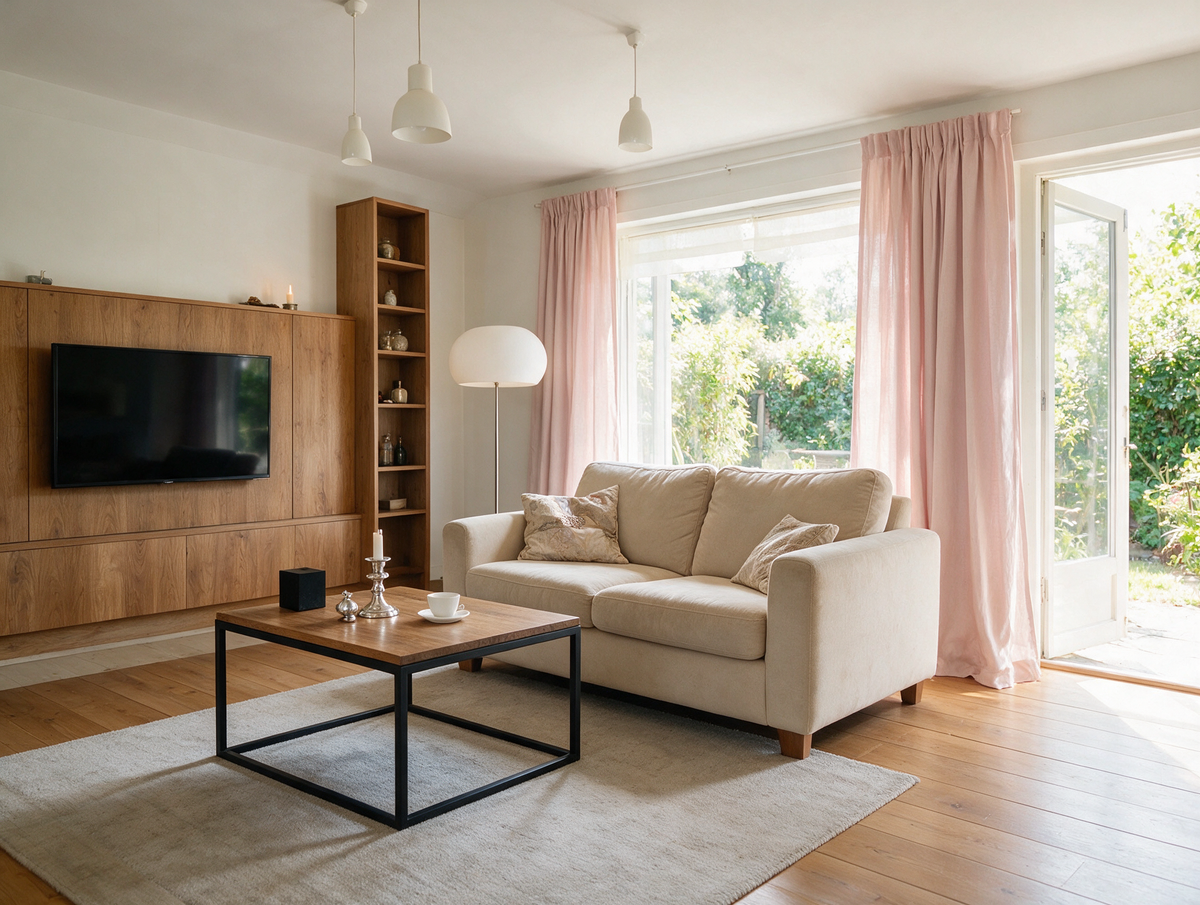
A Scandinavian sofa isn't "a sofa straight out of the communist era covered with a bedspread." It's:
Simple form (no quilting, gilding, fringes)
Light upholstery (gray, beige, maybe navy blue)
Wooden legs (visible, not hidden)
Comfort (because what's the point of a sofa you can't lounge on?)
A table is a table. Top + legs. No carvings, veneers, or glass inserts. Wood or white top, straight legs. It's like good bread – just flour, water, salt, yeast. And it's delicious.
Scandinavians love order. But not the "show-off" kind. Things are hidden away but easily accessible. White cabinets, open shelves (but not cluttered), baskets made of natural materials. It's like a well-organized closet – everything is visible, nothing sticks out.

Monstera, ficus, sansevieria – the bigger the leaves, the better. Pots? Simple, ceramic, in natural colors. No plastics pretending to be antique vases. It's like no-makeup makeup – naturalness is trendy.
Candles are essential. But not scented like "vanilla paradise" or "ocean breeze." Odorless, white, and simple. Candlesticks? Metal, glass, ceramic. The simpler, the better. It's like classical music – it needs no frills.
Pillows, blankets, rugs – but in moderation. Not "an entire couch covered in pillows like Aunt Krysia's." Two or three pillows, one blanket carelessly thrown over. A rug under the coffee table. Texture is more important than quantity.
Large windows without heavy curtains. Maximum daylight. How do north-facing windows in a Polish apartment look? Mirrors, light colors, minimal curtains. You have to be resourceful, like Poland in the match against Brazil – determination and creativity.
No fluorescent bulbs! Warm LED light (2700-3000K). Multiple sources:
A lamp hanging over the table (simple form, maybe industrial)
Sofa table lamps (ceramic or wooden base)
Candles (lots of candles)
LED garlands (subtle, not like a Christmas tree)
47m² in a block of flats isn't a Swedish villa. But Scandinavian minimalism helps here:
Bright colors magnify
Less furniture = more space
Multifunctionality (coffee table with storage, sofa with storage)
Not everyone can buy designer furniture from Copenhagen. Alternatives:
IKEA (obvious, but it works)
Polish brands making minimalist furniture
DIY (paint old furniture white)
Thrift stores and OLX (vintage with character)
We find it hard to throw things away. "What if it's useful?" It's like losing weight – we know what to do, but it's hard to get started. The small steps approach:
Start with one room
Throw away/give away 5 things a week
Rule: something new comes in = something old comes out

White + white + white = boring. Add textures, shades, and natural materials. This is a home, not an operating room.
An entire home from one catalog is like dressing head-to-toe at one chain store. Mix and match – combine IKEA with local finds, pieces with character.
Minimalism doesn't mean cold. Soft blankets, warm lighting, personal touches. This is your home, not a showroom.
A light-colored sofa, a wooden coffee table, and a good armchair. Maybe a large photo on the wall, or a series of small ones in identical frames. A plant in the corner. A blanket on the sofa. Done.
A bed with wooden legs, white sheets, maybe one pillow with a delicate pattern. Two nightstand lamps (symmetry!). Nothing more. This is a place to sleep, not a storage unit.
White fronts, wooden countertops (or imitation wood). Open shelves for pretty dishes. Potted herbs on the windowsill. Everything is within reach, yet hidden. Like a good restaurant – clean, practical.
White tiles, wooden accents. A laundry basket made of natural materials. White or gray towels. One plant (that likes moisture). A candle by the bathtub. Simplicity.
Scandinavian style isn't a religion – it's an inspiration. You don't have to throw everything away and live in a white box. Take what works for you:
Bright colors (brighten our cloudy days)
Natural materials (reminding you of nature outside your window)
Minimalism (less cleaning!)
Coziness (because the Polish climate requires it)
Remember: Scandinavian style is a means, not an end. The end is a home you feel good in. Whether it's pure Scandinavia or Scandinavia with a Polish accent (a Cepelia rug? Why not!) – the important thing is that it's yours.
For Pillovely, "the love of home" knows no bounds. She can come from Denmark, Sweden, or Norway, but she'll find her home in a Polish M-3. And it will be hygge. Or, in Polish, it will be homely.
Finally: the best Scandinavian home is one where you can drink tea without worrying about staining the white sofa. Because a home is for living in, not for looking at. Skål! (or, as we say, cheers!).
Loveseat - What Is It, Who Is It For and How to Choose the Right One?
A loveseat is one of those pieces of furniture that can completely change how a room works. It is smaller than a classic sofa, more generous than a single armchair and often easier to place in compact interiors. A loveseat can create a cosy sitting area in a small living room, soften a bedroom corner, complete a reading nook or work as an additional seat next to a larger sofa. Its strength lies in proportion: it gives you the feeling of a sofa without taking over the whole room.
Read moreabout Loveseat - What Is It, Who Is It For and How to Choose the Right One?
EU vs UK Bed Sizes – Will UK Bedding Fit a European Bed?
European beds are 200 cm long, UK beds 191 or 198 cm. A simple EU vs UK bed size table in cm – and what it means for your mattress and fitted sheets.
Read moreabout EU vs UK Bed Sizes – Will UK Bedding Fit a European Bed?
Autumn colors at home – shades that bring peace and warmth
Do you remember autumn from your childhood, when the leaves changed color like a kaleidoscope, and your mom would pull out the pumpkin-colored sweater she'd worn since college? Or those evenings in front of the TV while a storm raged outside, and the lamplight in the house gave everything a warm, amber hue? Those were the days when no one talked about "color palettes" or "color stories"—colors simply existed, as natural as breathing. Today, when we can choose from 50 shades of gray (and no, I'm not talking about THAT book), we sometimes lose track of what truly makes a home feel cozy. At Pillovely, we believe that autumn colors aren't a trend—they're a return to what makes us feel safe. Because "You are someone"—someone who deserves a space filled with colors that snuggle like a grandma's blanket.
Read moreabout Autumn colors at home – shades that bring peace and warmth



Share:
Boho in autumn – how to warm up the interior with natural accessories
Natural materials in the arrangement – wood, stone and fabrics play the main role