


- by Daniel Pawlik
Slatted bed base – which slatted bed base fits your mattress and bed, and what should you look out for?
- by Daniel Pawlik
A slatted frame is one of those pieces of furniture you rarely think about. You don't see it, and hopefully, you don't hear it either – yet it determines something that matters every day: the quality of your sleep. If you wake up feeling run-down, you often blame the mattress. However, the fault is just as often one level deeper. Perhaps you remember your grandparents' bed, which creaked softly with every movement because the frame was made of simple planks. Or your first own bed in your student apartment, whose roll-up slatted frame warped a little more with each move.
Today, a good slatted frame is no longer a minor detail but the silent foundation for restful nights. In this guide, we show you what types are available, what to look for when buying, and how to find the right model for your mattress and bed.
A slatted frame primarily consists of wooden slats – usually made of beech, birch, or other elastic woods – attached to a frame. They provide the necessary springiness and ventilation for the mattress. However, not all frames are the same.
The three main variants:
Rigid slatted frame: The classic. The slats are firmly anchored in the frame, without adjustment options. Advantages: robust, durable, inexpensive, maintenance-free. Disadvantages: no adaptation to body zones, less comfort for stomach and side sleepers.
Adjustable slatted frame: The head and foot sections can be raised manually or electrically. Advantages: high comfort for reading, watching TV, or having breakfast in bed, ideal for people with back problems or for seniors. Disadvantages: more expensive, mechanical elements require occasional maintenance.
Roll-up slatted frame: Made of flexible slats attached to a textile band that can be rolled up like a mat. Advantages: very inexpensive, ideal for guest rooms or temporary solutions, easy to transport. Disadvantages: less springiness, shorter lifespan, less ergonomic support.
Which slatted frame is right for you depends on your daily routine, budget, and sleeping habits. If you spend eight hours a day in bed, you should invest in a high-quality model. For guest beds or second homes, a simple roll-up slatted frame is often sufficient.
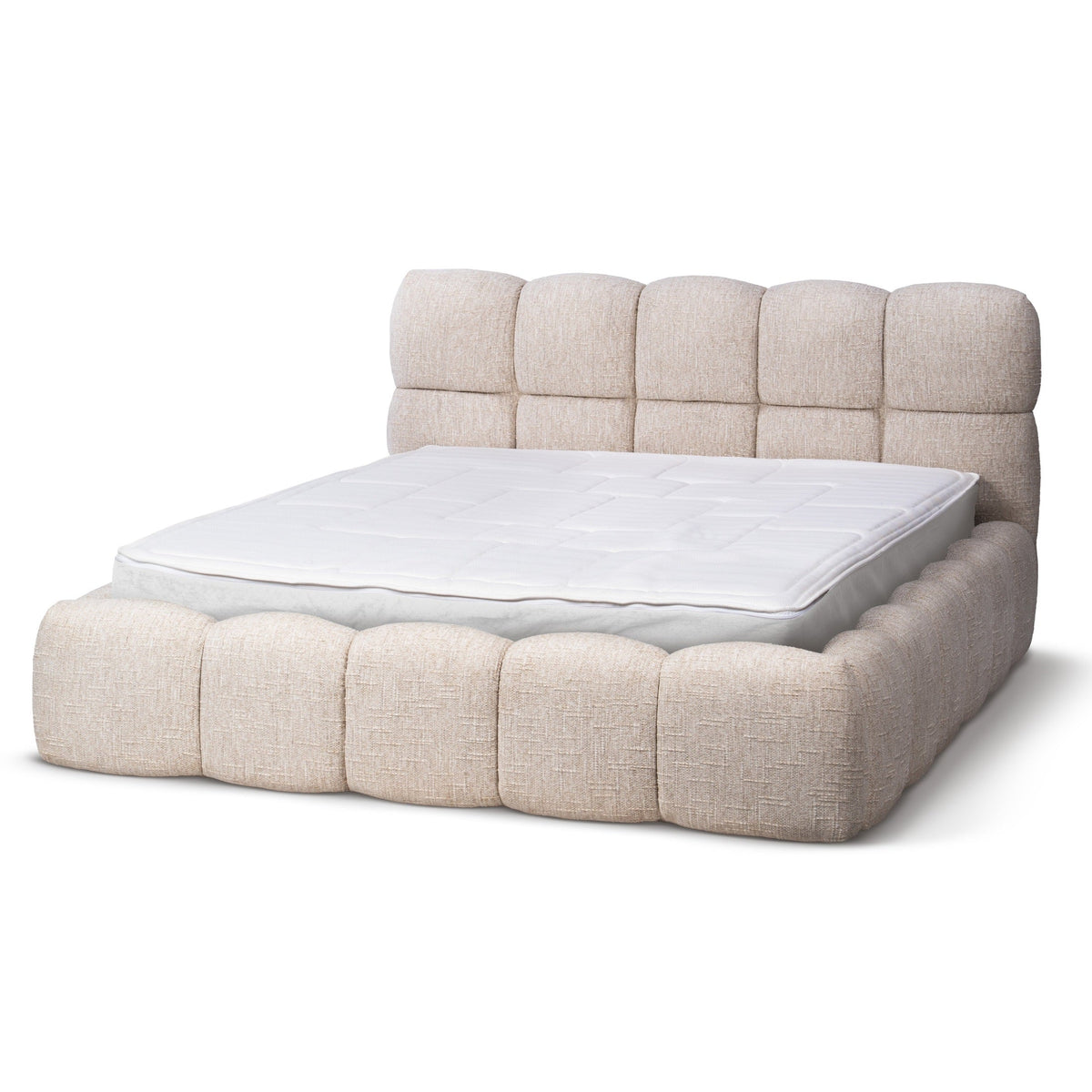
Many models in the upholstered beds category at Pillovely already come with a matching slatted frame – this saves you the hassle of a separate search and ensures that the bed and frame are optimally coordinated. You can also find more about choosing the right bed in our bed buying guide.

Not every mattress harmonizes with every slatted frame. Choosing the wrong model significantly shortens the lifespan of both components. Here's an overview of the most common combinations.
For cold foam mattresses:
An ideal slatted frame has many closely spaced slats – preferably at least 28. The gaps should not be too large, otherwise the foam will deform through the cracks. An adjustable model with firmness adjustment in the pelvic area also adapts to the body contour.
For pocket spring mattresses:
These mattresses require less springing from the frame because the internal springs take on that task. A simple rigid slatted frame or a roll-up slatted frame with sturdy slats is usually sufficient. Good ventilation is important – otherwise, pocket springs are sensitive to moisture.
For box spring mattresses:
A slatted frame for a box spring bed is not necessary in its classic form. Box spring beds have their own spring box base, which takes on the role of the slatted frame. However, if you want to place a box spring mattress on a normal bed, you should look for a very stable, high frame – the mattress is significantly heavier than classic models.
For latex mattresses:
Similar to cold foam, they need a densely spaced slatted frame with at least 28 slats. Latex is particularly heavy and puts a lot of strain on the frame – a stable model with high load capacity is worthwhile here.
You can find a suitable mattress in the mattresses category at Pillovely – ideally together with the corresponding bed frame. Buying both together saves time and ensures that all components truly harmonize. If you want to assemble both individually, you'll find the right assortment in the beds and mattresses category.

The number of slats is one of the most important quality indicators. As a rough rule of thumb: the more slats, the better the adaptation to the body.
Recommended number of slats:
Up to 20 slats: simple standard, sufficient for occasional sleeping (guest bed)
24 to 28 slats: good medium standard, suitable for most mattresses
32 to 42 slats: high-quality segment, especially recommended for cold foam and latex
Over 42 slats: premium segment, usually with zone division and firmness adjustment
In addition to a sufficient number of slats, a good slatted frame also has a zone division. This means that the frame is divided into several areas that spring differently. Most often, there are five or seven zones for the head, shoulders, back, pelvis, and legs. This allows for an ergonomically correct body posture during sleep.
Firmness adjustment:
With better models, individual zones can be adjusted to be firmer or softer. This is particularly important in the pelvic area – this is where the body has the most weight, and the correct firmness determines the spine's position. Those who suffer from a lot of back pain or sleep on their side will significantly benefit from this feature.
It is highly recommended to test a slatted frame by lying on it at home. A frame that seems perfect in the furniture store might react differently at home – depending on the mattress, room temperature, and user. Reputable providers therefore offer longer return periods.
A practical rule of thumb: The greater the body weight, the more slats and the more stable the frame should be. For people over 90 kilograms, a model with at least 32 slats and a reinforced middle section is recommended.
A slatted frame must fit the bed size. This sounds trivial, but it's the most common purchasing mistake. The size of the frame is determined precisely by the sleeping surface of the bed.
Standard sizes at a glance:
Slatted frame 90x200 – single bed, student and guest rooms, classic size for one person
100x200 – slightly wider, more comfortable for one person
120x200 – intermediate size for single persons with freedom of movement
Slatted frame 140x200 – small double bed, classic size in many German households
160x200 – the most common size for couples
180x200 – current standard for double beds
200x200 – spacious double bed for maximum freedom of movement
For double beds wider than 160 cm, two slatted frames are usually used side by side (two 80 x 200 or 90 x 200). This has the advantage that each person can choose their own firmness setting.
Check load capacity:
A high-quality slatted frame should have a load capacity of at least 120 kilograms per person. For heavier individuals, reinforced models with up to 200 kilograms load capacity are available. These often have additional central supports and thicker slats.
Check before buying:
Measure the internal dimensions of the bed accurately
Check the height of the frame – it must fit
Test the fit in the holder
For electric models, note the plug position
Models like the Neria upholstered bed with integrated LED lighting or the STRATUS upholstered bed with a bed box and matching slatted frame offer harmonious overall concepts. When buying a complete bed, you don't have to search for a separate frame – and you can be sure that all components are coordinated. If you want to assemble both individually, you'll find the right assortment in the beds and mattresses category.
How long does a good slatted frame last? A high-quality slatted frame lasts between ten and fifteen years. With daily use, it should be checked and replaced if necessary after a maximum of ten years, because the springing wears out over time.
Can an adjustable slatted frame also be retrofitted electrically? Yes, there are motor inserts that can be installed later. However, it is usually more economical to buy a motorized model directly.
What does a good slatted frame cost? A simple roll-up slatted frame is available from 50 euros. Solid rigid models start at around 100 euros. A high-quality adjustable frame costs 300 to 800 euros, electric premium models up to 2000 euros.
How do I know if my slatted frame is defective? If the frame squeaks, individual slats are loose, or the springing diminishes. Back pain in the morning is also a warning sign. A slatted frame test by lying on a new model will immediately show the difference.
Is a slatted frame necessary for a box spring bed? No. Box spring beds have a built-in spring box as a base. An additional slatted frame is superfluous and would alter the construction.
Can I use a 140x200 slatted frame for a 160x200 bed? No. The frame must fit the sleeping surface exactly. Incorrect sizes lead to uneven stress, shortened lifespan, and improper fit in the mattress.
A good slatted frame is the silent foundation of every restful night. It helps determine how you wake up in the morning – with a back ready for the day, or with the feeling that the night has cost you more than it has given. At Pillovely, you will find beds where all components are coordinated – from the frame to the slatted frame and the mattress. So that at the end of the day, you can simply sleep, without any piece of furniture getting in your way.
Pillovely – for those who want more.
If you liked this text, be sure to check out our other inspirations:
Furnishing a teenager's room – how to design a room that teenagers really like?
Loveseat - What Is It, Who Is It For and How to Choose the Right One?
A loveseat is one of those pieces of furniture that can completely change how a room works. It is smaller than a classic sofa, more generous than a single armchair and often easier to place in compact interiors. A loveseat can create a cosy sitting area in a small living room, soften a bedroom corner, complete a reading nook or work as an additional seat next to a larger sofa. Its strength lies in proportion: it gives you the feeling of a sofa without taking over the whole room.
Read moreabout Loveseat - What Is It, Who Is It For and How to Choose the Right One?
EU vs UK Bed Sizes – Will UK Bedding Fit a European Bed?
European beds are 200 cm long, UK beds 191 or 198 cm. A simple EU vs UK bed size table in cm – and what it means for your mattress and fitted sheets.
Read moreabout EU vs UK Bed Sizes – Will UK Bedding Fit a European Bed?
Autumn colors at home – shades that bring peace and warmth
Do you remember autumn from your childhood, when the leaves changed color like a kaleidoscope, and your mom would pull out the pumpkin-colored sweater she'd worn since college? Or those evenings in front of the TV while a storm raged outside, and the lamplight in the house gave everything a warm, amber hue? Those were the days when no one talked about "color palettes" or "color stories"—colors simply existed, as natural as breathing. Today, when we can choose from 50 shades of gray (and no, I'm not talking about THAT book), we sometimes lose track of what truly makes a home feel cozy. At Pillovely, we believe that autumn colors aren't a trend—they're a return to what makes us feel safe. Because "You are someone"—someone who deserves a space filled with colors that snuggle like a grandma's blanket.
Read moreabout Autumn colors at home – shades that bring peace and warmth




Share:
Decorating a Teenager's Room - How to Design a Space They'll Really Love?
Beistelltisch – welcher passt zu Sofa und Wohnzimmer und wie setzt man ihn richtig ein?