


- by Daniel Pawlik
Living Room Rug – How to Choose the Perfect Size, Shape, and Material for Your Interior?
- by Daniel Pawlik
A rug is a piece of furniture that isn't directly called furniture, yet it functions as the most important one. It divides space, warms the floor, dampens noise, softens acoustics, and keeps bare feet from getting cold on a Sunday morning. A well-chosen living room rug can tie an arrangement into a cohesive story. A poorly chosen one looks like a giant tissue stuck in the middle of the room.
At Pillovely, we believe that every detail in an interior says something about you – and a rug is one of the most distinct voices in a room. This guide will walk you through all the decisions: size, shape, material, placement relative to furniture, and also show you which rug to choose for a living room when you live with a child or a dog. No theorizing, just concrete advice.
Before you answer the question "what rug should I buy for my living room," it's worth pausing to consider a few fundamentals. Each of the following parameters affects how the rug will look, how long it will last, and how much maintenance it will require.
Five things to consider before purchasing:
Size – the biggest and most common mistake. A rug that is too small "floats" in the middle of the room and visually shrinks the living room.
Shape – rectangular (classic), round (trendy in smaller rooms), irregular (a strong accent in modern interiors).
Material – wool, cotton, jute, viscose, synthetic fibers (polyester, polypropylene). Each has different functional properties.
Pile height – short (up to 1 cm), medium (1–3 cm), long/shaggy (over 3 cm). Short pile = easier cleaning.
Color and pattern – muted backgrounds hide dirt, strong patterns make an impression but require a "calm" rest of the room.
Wool – warm, durable, self-cleaning (lanolin), expensive, but ages beautifully. A premium classic.
Cotton – lightweight, machine washable, ideal for living rooms with children or in summer houses.
Jute and sisal – natural plant fibers, ecological, boho/Scandinavian style, but rough.
Viscose – beautiful sheen and softness, but sensitive to moisture and stains.
Polypropylene – synthetic, very practical, easy to clean, low cost.
Blends (wool + cotton, wool + viscose) – a compromise between aesthetics and practicality.
You can find the current offer of rugs tailored to modern interiors in the accessories tab – it's worth browsing models in neutral shades (ecru, beige, olive), as these usually blend well with sofas.

The size of the living room rug is the decision that dictates everything. Most people buy a rug that is too small – because it seems cheaper, lighter to transport, safer. And they almost always regret it.
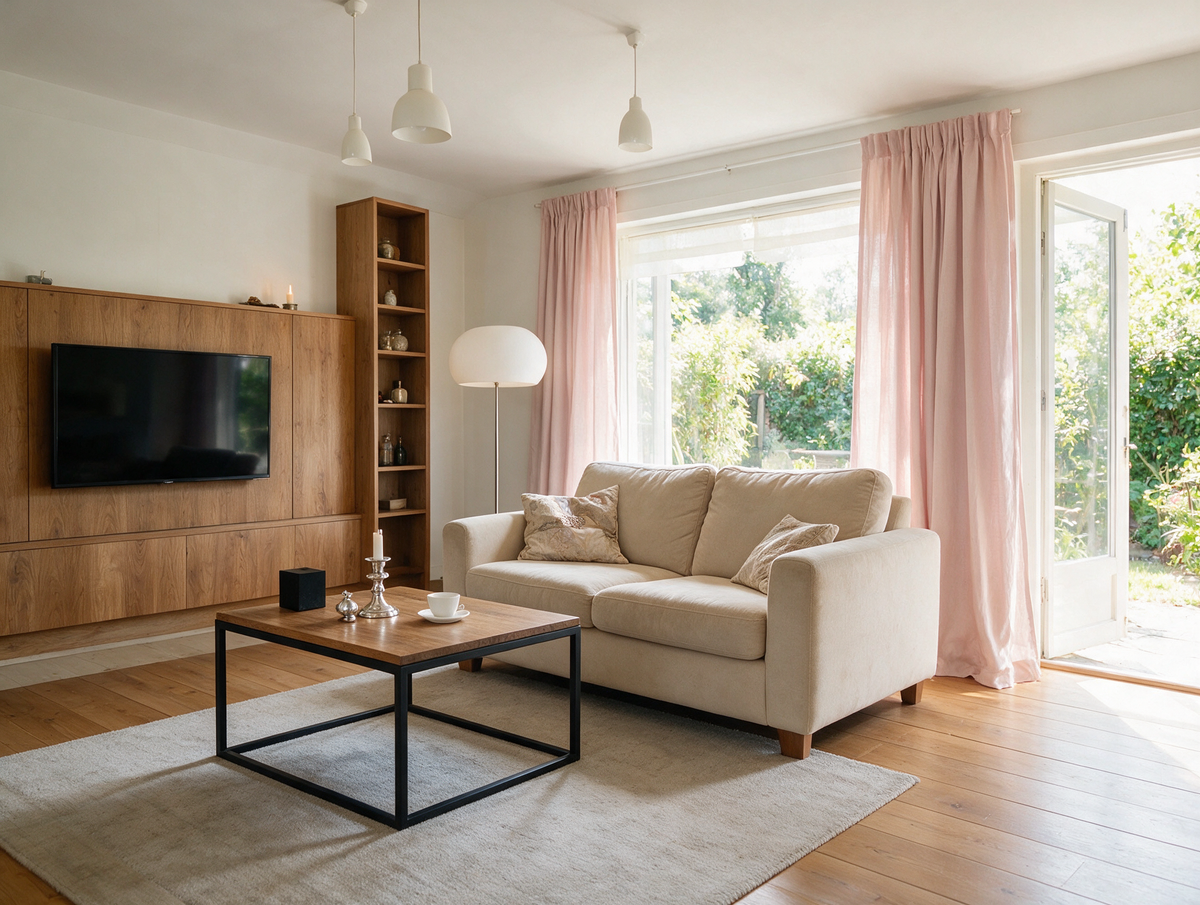
Layout 1: Entire sofa on the rug (best). The rug is large enough to accommodate the entire sofa plus a coffee table plus a minimum of 20–30 cm extra on each side. This solution creates a "living room zone" – everything on the rug belongs to one composition. Good practice in living rooms 18 m² and larger.
Layout 2: Only the front legs of the sofa on the rug (compromise). The rug extends under the front legs of the sofa. This is a good solution for medium-sized living rooms where a large rug would be overkill, and a small one disproportionate.
Layout 3: Rug only under the coffee table (smallest). A safe option in very small living rooms or when the sofa is against the wall. The rug size for the living room in this layout should be at least 30 cm wider on each side than the coffee table.
160 × 230 cm – minimum for a small living room with a two-seater sofa,
200 × 290/300 cm – the golden standard for living rooms 16–20 m²,
240 × 340 cm – for larger living rooms with a three or four-seater sofa,
300 × 400 cm – for large open-plan spaces,
160 / 200 cm diameter (round) – for smaller rooms with a round table.
Regardless of the layout, the rug should extend a minimum of 20–30 cm beyond the edges of the sofa on each side. Less looks like too tight a mat. More (50+ cm) creates a "rug as the main star" effect, ideal for Scandinavian and Japandi styles.
The question "rug under living room table or under sofa" comes up particularly often in apartments with open kitchens or in living rooms combining a lounge area with a dining area. The answer depends on the layout – and it's not always "either-or."
In a living room with an open dining area, the best solution is two separate rugs, each defining its zone:
rug under the sofa – larger, in a neutral color, soft to the touch,
rug under the dining table – easy to clean, low pile, with a simple pattern.
This visually separates the zones, makes the space more organized, and gives each part of the living room its own character.
If you're choosing a rug for under the dining table, follow one rule: the rug must be large enough so that chairs pulled out from the table still stand on it with all four legs. In practice, this means:
table 90 × 160 cm → rug minimum 200 × 290 cm,
table 100 × 200 cm → rug minimum 240 × 340 cm,
round table 120 cm diameter → round rug minimum 240 cm diameter or rectangular 240 × 240 cm.
The rule of "60–70 cm extra on each side of the table" is a classic one worth sticking to. A chair whose back legs fall off the rug when pulled back is irritating on a daily basis.
In a typical lounge living room, the rug should be the center of the seating area. Center it relative to the sofa and coffee table, not to the room's walls – this is a seemingly subtle difference that, however, dramatically changes the perception of the interior.
A living room with children is a living room with juice stains, cookie crumbs, and crayon marks. A living room with a dog also means fur, muddy paws, and occasional organic mishaps. When choosing a rug for a living room with a dog or a rug for a living room with a child, be guided by practicality and acceptance – that the rug will be used, not admired.
Polypropylene – the king of practicality. Stain-resistant, can be cleaned with soap and water, low cost, long lifespan. In cheaper versions, it looks somewhat synthetic – choose more expensive models with a better texture.
Short-pile wool – has natural lanolin that repels dirt and moisture. Expensive, but luxurious and ecological.
Machine-washable cotton – a lifesaver in many situations. Lighter cotton rugs can simply be thrown into the washing machine at 30°C.
Flat-woven "kilim" – no long pile = no place for fur and dust. Easy to vacuum, easy to wipe.
Viscose – beautiful, but sensitive. A wet stain leaves a permanent mark. Not suitable for homes with children.
Long pile / shaggy – a magnet for fur, crumbs, dust. Washing/vacuuming takes ages. Poor with cat claws and dog paws.
Light, solid colors without impregnation – the first tea stain ends their career.
A rug for a living room with a child or a dog should have a subtle pattern or a mixed color. A pattern masks stains before you can clean them. Muted blends of beige, brown, and warm gray are winners here – they don't show everyday "mishaps."
Regardless of the material, an anti-slip underlay for the rug is an expense of 50–150 PLN that saves the day daily – the rug doesn't slip under children's feet, under a dog's paws running across the floor, or under the sofa being moved for vacuuming.

What size rug should I choose for the living room?
Ideally, the rug should extend at least 20–30 cm beyond the edges of the sofa. A model that is too small can disrupt the proportions of the interior.
What rug material is easiest to clean?
Polypropylene is one of the most practical materials – it's stain-resistant, durable, and easy to maintain.
Will a round rug work in the living room?
Yes, especially in smaller rooms or when paired with a round coffee table.
What rug should I choose for a home with children or pets?
Short-pile rugs made of polypropylene, cotton, or wool are best.
Should the rug be under the sofa?
Yes, this is the most recommended solution. The rug helps to visually connect the sofa, table, and other elements of the lounge area.
What rug color is most versatile?
Beige, ecru, warm gray, and olive shades are easy to match with most modern living room arrangements.
The best living room rug is one that still looks good after a year of use, and even better after five years, because it has become an integral part of your home's actual life.
Three things to take away from this text:
Choose larger, not smaller – rug size for the living room is more important than pattern and color combined.
Match the material to your lifestyle – wool and cotton for aesthetes, polypropylene for families with children and pets.
Remember the relationship with furniture – sofa, coffee table, and rug are one composition, not three separate decisions.
At Pillovely, we design furniture that feels good on a rug – one you want to return to with bare feet. You can find current rug proposals tailored to modern arrangements in the rug category – choose those in natural colors (ecru, beige, olive, warm gray), as they best complement the sofas in our offer.
Pillovely – for those who want more. More warmth. More softness. More at home.
If you liked this text, be sure to check out our other inspirations:
Living room wall colors – what to choose for a modern look?
Loveseat - What Is It, Who Is It For and How to Choose the Right One?
A loveseat is one of those pieces of furniture that can completely change how a room works. It is smaller than a classic sofa, more generous than a single armchair and often easier to place in compact interiors. A loveseat can create a cosy sitting area in a small living room, soften a bedroom corner, complete a reading nook or work as an additional seat next to a larger sofa. Its strength lies in proportion: it gives you the feeling of a sofa without taking over the whole room.
Read moreabout Loveseat - What Is It, Who Is It For and How to Choose the Right One?
EU vs UK Bed Sizes – Will UK Bedding Fit a European Bed?
European beds are 200 cm long, UK beds 191 or 198 cm. A simple EU vs UK bed size table in cm – and what it means for your mattress and fitted sheets.
Read moreabout EU vs UK Bed Sizes – Will UK Bedding Fit a European Bed?
Autumn colors at home – shades that bring peace and warmth
Do you remember autumn from your childhood, when the leaves changed color like a kaleidoscope, and your mom would pull out the pumpkin-colored sweater she'd worn since college? Or those evenings in front of the TV while a storm raged outside, and the lamplight in the house gave everything a warm, amber hue? Those were the days when no one talked about "color palettes" or "color stories"—colors simply existed, as natural as breathing. Today, when we can choose from 50 shades of gray (and no, I'm not talking about THAT book), we sometimes lose track of what truly makes a home feel cozy. At Pillovely, we believe that autumn colors aren't a trend—they're a return to what makes us feel safe. Because "You are someone"—someone who deserves a space filled with colors that snuggle like a grandma's blanket.
Read moreabout Autumn colors at home – shades that bring peace and warmth



Share:
Wall colors for the living room – which to choose for a modern interior?
Pilla's Reading Corner: "Fables for Robots" - Stanisław Lem