


- by Daniel Pawlik
Living room rug - What size, shape, and color best suits your sofa?
- by Daniel Pawlik
A living room without a rug often feels like a song without a bassline – something is missing, even if you can't immediately pinpoint it. A good living room rug not only brings warmth and acoustics to the room but also connects individual furniture pieces into a harmonious whole. Nevertheless, choosing one isn't easy: What size fits the sofa? Which color matches the wall paint? And how do you care for it when kids and dogs are in the picture? In this guide, we'll show you step-by-step how to find the right rug and what truly matters in everyday life.
The question "Which rug for the living room?" has no blanket answer, as every room tells its own story. Nevertheless, there are clear criteria you can use as guidance.
Important factors when buying:
Room size – determines the minimum and maximum dimensions of the rug
Furniture arrangement – the placement of the sofa, armchair, and coffee table determines the shape
Room style – modern, classic, Scandinavian, retro – each style has suitable rug types
Color scheme – a rug can soothe, accent, or visually open up the room
Materials – wool, cotton, viscose, jute, or synthetic fibers have different properties
A living room rug fulfills several tasks simultaneously in everyday life. It absorbs sound, insulates against cold floors, and brings visual warmth to the room. Therefore, when looking for a rug for the living room, you should not only consider the design but also its function and maintenance intensity.
A quick checklist before buying:
Measure the dimensions of the seating group
Define the room's style
Analyze the living room's color palette
Honestly assess the maintenance effort
Set a realistic budget
A practical tip: If you're unsure, start with a neutral option. A gray living room rug in a subtle melange suits almost any sofa and can later be easily enhanced with accessories like cushions or blankets. More details on choosing neutral tones can be found in our separate guide on living room colors.
Materials and their properties briefly explained:
Wool – natural, durable, somewhat dirt-repellent, slightly more expensive to purchase
Cotton – soft and usually washable, ideal for small to medium-sized rugs
Viscose – silky sheen, elegant look, but rather delicate
Jute and Sisal – natural, rustic, perfect for Scandinavian and Boho rooms
Synthetic fibers – easy to care for, robust, often stain-repellent
If sustainability is important to you, pay attention to natural materials and durable craftsmanship. A high-quality rug will accompany you for many years – much like a well-chosen piece of furniture that doesn't go out of style.

The living room rug size is one of the most common pitfalls when buying. A rug that is too small looks lost, one that is too large overloads the room. The most important rule of thumb: It's better to be a bit too big than too small.
Three proven arrangement variants:
All furniture legs on the rug – the most generous concept, ideal for large rooms. The rug must extend at least 60 cm beyond the sofa.
Only the front legs on the rug – the classic middle ground. It visually connects the seating group without overwhelming the room.
Rug smaller than the sofa – only recommended in very small rooms or as a mini-layer.
The most common standard sizes for a living room rug:
160 × 230 cm – ideal for compact sofas (2–2.5 seater)
200 × 290 cm – suitable for medium seating groups with a coffee table
240 × 340 cm – the standard solution for larger living rooms
300 × 400 cm – suitable for large corner sofas and open living areas
Rules of thumb for calculation:
The rug should extend at least 20–30 cm beyond the sofa on the right and left.
There should be 40–60 cm of rug space in front of the sofa for the coffee table.
There should be at least 30 cm of space between the rug and the wall so that the room can breathe.
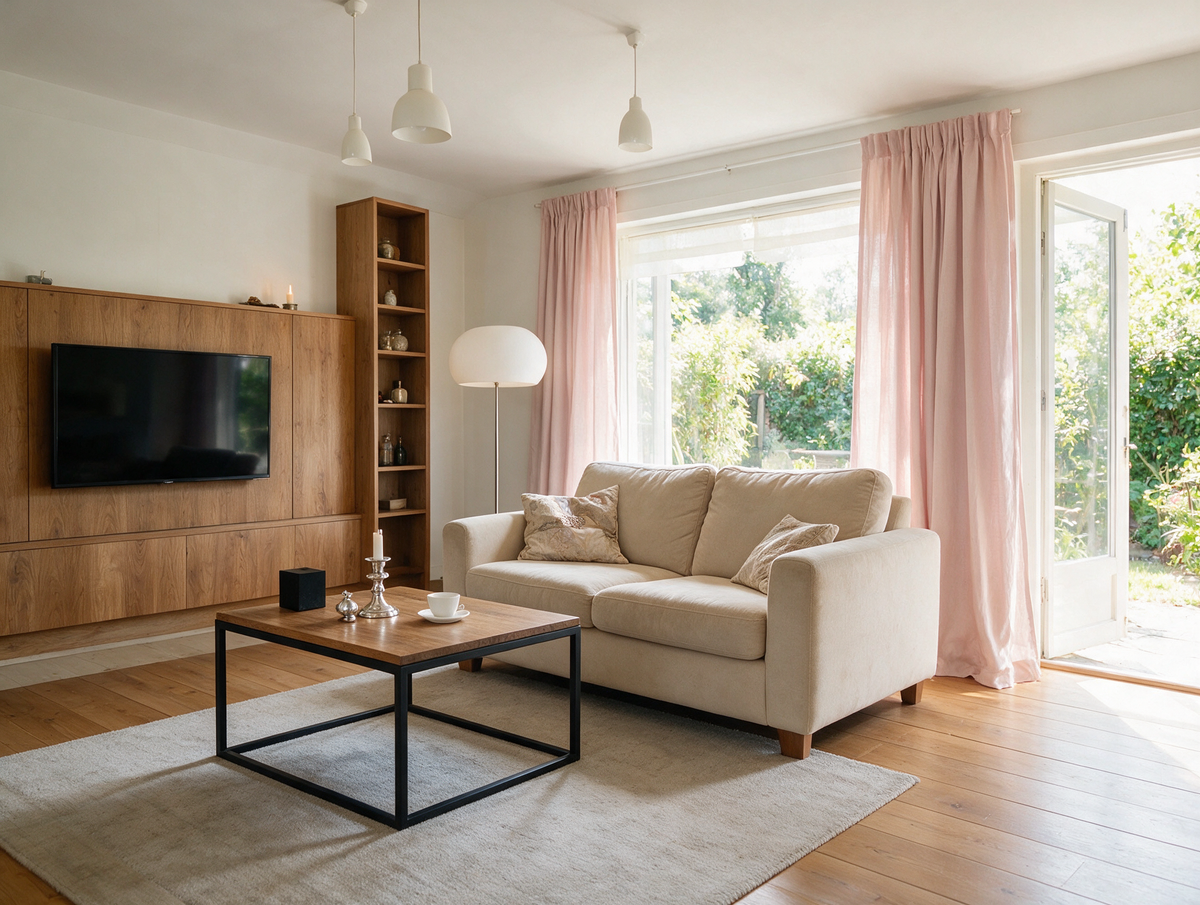
If you own a corner sofa, you should align the rug along the longer side and ensure that the sofa's leg line also ends on the rug. This creates a calm, cohesive seating group instead of a scattered arrangement.
Whether the rug is under or in front of the sofa is not just a matter of taste, but also of how it affects the room's perception. Both options are valid – and have their own advantages.
Rug under the sofa (entirely or with the front legs):
conveys a generous, "connected" effect
ideal for medium to large rooms
the seating group appears as its own clearly defined island
particularly elegant with sofas with visible legs
Rug only in front of the sofa:
saves material and budget
typical for small rooms or rental apartments
the coffee table becomes the visual center
can look a bit "cut off" if the dimensions are not right
If you want the best of both worlds, opt for the classic middle ground: The front legs of the sofa rest on the rug, while the back remains free. This look works well with both a modern living room rug and more classic models. The coffee table should also be entirely on the rug, otherwise, it creates an unsettling break in the middle of the room.
A practical tip: Before buying, you can mark the planned rug size on the floor with painter's tape. This way, you immediately see if the proportions are right or if the rug would look too small later. These five minutes of work often save expensive mispurchases.
For open-plan living areas where the living room and dining room merge, a larger, continuous rug is worthwhile. It defines the zones and creates a calm center in the room. More on zoning open spaces can be found in our corresponding guide.
With a dog, cat, or small children, the rug becomes a daily stress test. Cocoa stains, pet hair, small traces of family life – the rug is expected to withstand all of this without looking old after three months.
Easy-care materials compared:
Low-pile rugs – easiest to clean, crumbs and hairs hardly get caught
Synthetic fiber rugs (polypropylene, polyester) – robust, stain-resistant, often machine washable
Flat weave – durable, ideal for families with high daily traffic
Outdoor rugs – increasingly used indoors too, because they are virtually indestructible
Wool – naturally dirt-repellent, but slightly more delicate than synthetic fibers
What you should look for:
as dense a pile as possible without overly long loops (claws easily get caught)
material that tolerates moisture (for small "accidents" in everyday life)
easy-care surface, preferably without a deep pile
muted colors or a slight melange look that makes stains less visible
A grey living room rug with a mottled look is often the smart choice here: It camouflages crumbs, dog hair, and small traces of family life. A rug for the living room in warm earthy tones like sand, caramel, or greige also copes well with everyday life – and suits almost any piece of furniture.
Everyday care tips:
vacuum regularly, ideally once a week
treat stains immediately with lukewarm water and a mild cleaner
ventilate the rug occasionally if possible
for synthetic fibers, plan professional cleaning every few years
This way, the rug remains a part of the home for years, a place you always enjoy stepping onto – barefoot, on a Sunday morning, with a cup of coffee in hand and your favorite record playing in the background.
Popular color trends for living room rugs:
Natural tones – sand, caramel, greige, warm beige for a tranquil living feel
Sage and muted olive green – fresh, modern, and surprisingly timeless
Dark anthracite – elegant and particularly contrasting with light sofas
Terracotta and rust – warm, inviting, perfect for nostalgically inspired rooms
Classic black and white – graphic, modern, and absolutely timeless
A good rug always tells a piece of personality in the end. Perhaps a warm caramel tone reminds one of the rug in their grandparents' living room, or maybe it's a bright model that suits a minimalist loft. The important thing is that you feel comfortable with it – day after day, Sunday after Sunday.

Which living room rug is most popular?
A classic low-pile rug in neutral tones like beige, grey, or greige suits most interior styles and is particularly easy to care for.
What size should a rug under the sofa be?
Ideally, the rug should extend at least 20–30 cm beyond the sofa on both sides. For larger seating groups, all furniture legs should be fully on the rug.
Which rug shape best suits the living room?
Rectangular rugs are the most versatile. Round models are suitable for compact seating areas, oval ones for open living spaces with soft shapes.
Which rug is suitable for allergy sufferers?
Low-pile synthetic fiber rugs or washable models are particularly good because they hardly retain dust and mites. Wool is a good alternative for those who prefer natural materials.
How does a rug in the living room appear modern?
Clean shapes, muted colors, and simple patterns appear most modern. Geometric lines or subtle melange effects emphasize a contemporary look.
Is a light-colored rug advisable with a dog or child?
Yes, if it's washable or made of stain-resistant fiber. Otherwise, it's better to opt for mottled or slightly darker tones – they are more forgiving of small accidents.
How do I prevent the rug from slipping?
An anti-slip mat under the rug is the simplest solution. Heavy furniture on the rug also keeps it in place.
If you want to give your living room more warmth and personality, take a look at our selection at Pillovely. In the categories sofas, corner sofas, and armchairs, coffee tables, and rugs, you'll find furniture and accessories that together create a room where you feel at home – Sunday after Sunday, story after story.
If you enjoyed this text, be sure to check out our other inspirations:
Sofa bed – which is the best and what should you look for when buying?
Loveseat - What Is It, Who Is It For and How to Choose the Right One?
A loveseat is one of those pieces of furniture that can completely change how a room works. It is smaller than a classic sofa, more generous than a single armchair and often easier to place in compact interiors. A loveseat can create a cosy sitting area in a small living room, soften a bedroom corner, complete a reading nook or work as an additional seat next to a larger sofa. Its strength lies in proportion: it gives you the feeling of a sofa without taking over the whole room.
Read moreabout Loveseat - What Is It, Who Is It For and How to Choose the Right One?
EU vs UK Bed Sizes – Will UK Bedding Fit a European Bed?
European beds are 200 cm long, UK beds 191 or 198 cm. A simple EU vs UK bed size table in cm – and what it means for your mattress and fitted sheets.
Read moreabout EU vs UK Bed Sizes – Will UK Bedding Fit a European Bed?
Autumn colors at home – shades that bring peace and warmth
Do you remember autumn from your childhood, when the leaves changed color like a kaleidoscope, and your mom would pull out the pumpkin-colored sweater she'd worn since college? Or those evenings in front of the TV while a storm raged outside, and the lamplight in the house gave everything a warm, amber hue? Those were the days when no one talked about "color palettes" or "color stories"—colors simply existed, as natural as breathing. Today, when we can choose from 50 shades of gray (and no, I'm not talking about THAT book), we sometimes lose track of what truly makes a home feel cozy. At Pillovely, we believe that autumn colors aren't a trend—they're a return to what makes us feel safe. Because "You are someone"—someone who deserves a space filled with colors that snuggle like a grandma's blanket.
Read moreabout Autumn colors at home – shades that bring peace and warmth



Share:
Sofa bed – which one is the best and what to look for when buying?
Wall unit – what is it and which models fit into modern living rooms?